SERIOUS TRAINING 35
Skill: The Forgotten Corner of Performance

Besides running and cycling, I also raced triathlon in the 1980s, 1990s, and early 2000s. I was a decent cyclist and runner, but a mediocre swimmer. I thought the key to getting faster in the water was more hours in the pool. I was wrong. I eventually figured out that the key to better swim performance was improving my skills. More hours done with poor technique only reinforced the problem. Unfortunately, I didn’t realize that until after my triathlon career—while I was watching a race.
In the early 2000s I lived in Scottsdale, Ariz. just outside of Phoenix. In 2010 I attended the Phoenix Ironman Triathlon as a spectator. The swim leg of the race is unique there. It’s done in a wide canal so spectators, like me, can walk along the course watching the swimmers below.
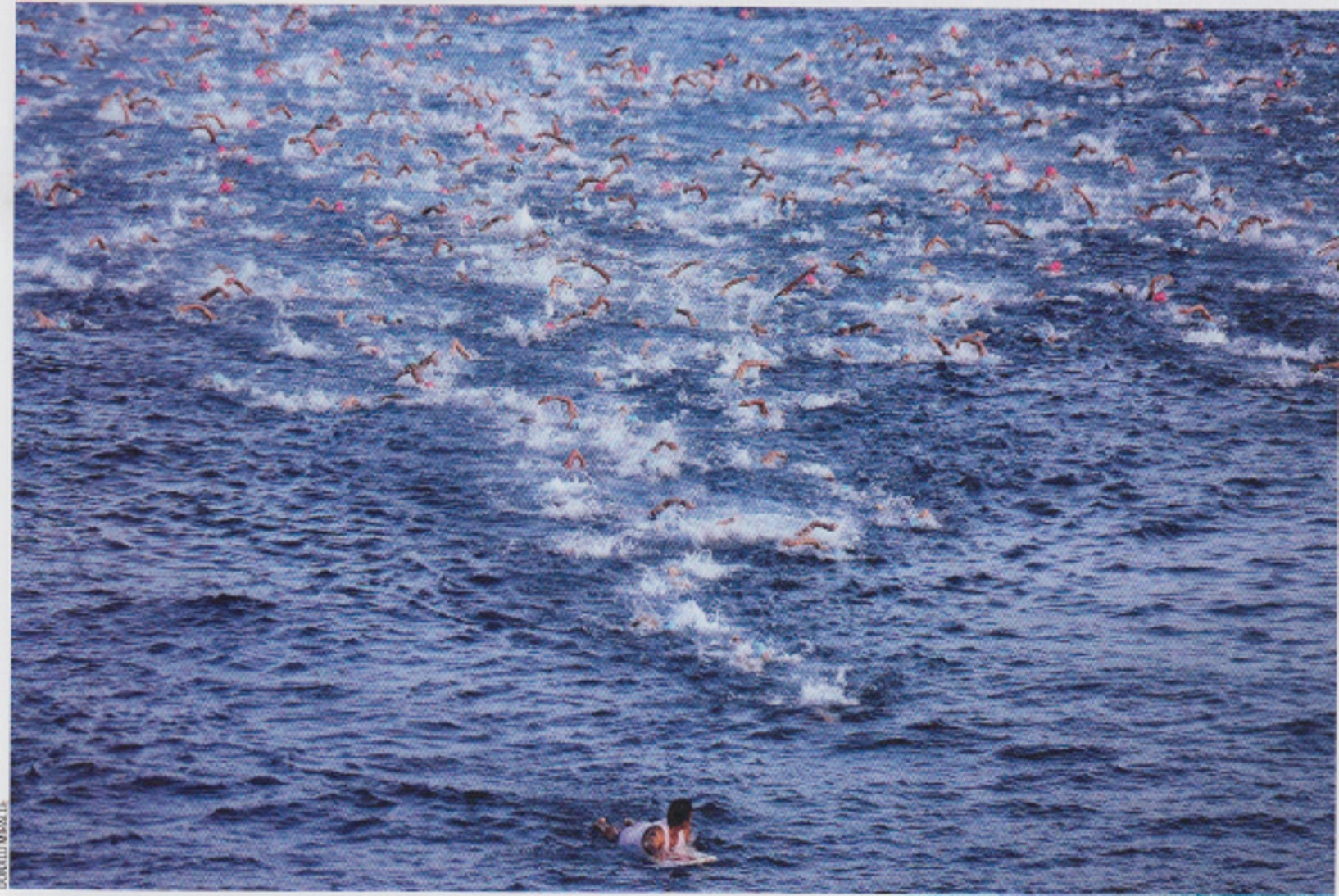
While watching the pros and age group elites I saw something I had never noticed before. Don’t know how I missed it. Instead of their hands entering the water near their heads and then reaching out under the surface like pool swimmers do, they were reaching above the water with high hands—like windmills. You can see what I mean in my picture from that race (below). Notice all the high hands. I don’t believe there are any using the pool swimmer’s, commonly taught, underwater reach. Instead, they were using what I came to realize was an open-water swimmer’s technique. I had never spotted that before.
This seemed strange at first. Just the opposite of what I thought I knew about swimming skills.
Why is that important? Swimming is, to a great extent, a skill sport. It’s as much like golf as it is running or cycling. As with golf, technique is critical in swimming—more so than in any other endurance sport I know of. A swimmer with poor technique (like me) either must work extremely hard to overcome the drag of the water, or swim super slow.
From this “aha” moment at the race came what I called the PDLC (posture, direction, length, and catch) swim skill teaching method. This is described in detail in my Triathlete’s Training Bible.
I went on to teach this method in my triathlon training camps throughout the 2010s and 2020s. Here’s how I do it. I have the campers swim a 500-meter test on the first day of a week-long camp. They are fresh. Then the next five days all they do is slow and easy swim drills to teach and reinforce the PDLC method which includes the above water, “windmill-type” reach. They never swim longer than 25 meters before resting. Each 25 is drills only. Slow and easy while focused on one skill. On the last day of the camp, when they are tired from several hours of training in three sports for a week, they repeat the 500-meter time trial.
Here’s what I found happened to their test times. Around 80% of the campers swam faster using the PDLC method even though they were very tired. They weren’t huge changes—usually only 5 to 10 percent faster than on day 1. But that’s after only a few days of drills and 15 to 20 hours of training in three sports.
Why is this important? Runners, cyclists, and athletes in other sports seldom give little more than lip service to skills. And yet it is a critical aspect of performance in every sport. Besides in the pool, I see poor technique all the time on the roads. Improving sport-specific movement skills is free speed. You don’t have to become physiologically more fit to reap the benefits. But it takes time—as in seasons—to master those skills.
Skills are a huge part of what scientists call “economy”—how much energy is expended, or wasted, while moving. It’s somewhat less obvious in most sports than it is in swimming, but there is a considerable amount of energy wasted due to poor skills among age group athletes regardless of sport. And it’s an easy fix, albeit quite time-consuming.
Let’s investigate the topic a little deeper to help you understand the importance, and how-to, of skill training.