SERIOUS TRAINING 21
If Some Is Good, Is More Better?

Looking back over what I’ve written here in the last few weeks, there’s one word I find a lot—consistent. The point I’ve tried to make is that there’s little doubt that you will perform at a higher level if you train consistently. But there’s a problem with this. Consistent is just one step from obsession. Obsessive training is hard to define as it seems that one athlete’s consistent training is another’s obsessive training. There appears to be a thin difference between them.
At a glance, they look similar as both involve frequent training, structure, and discipline. The difference isn’t how muchyou train, but how you relate to training and how well it serves your long-term development.
I’ll give you an example of someone who teetered on the thin edge between consistent and obsessed. See what you think.
In the 1980s I owned a running store in Fort Collins, Colo. The running boom was still in its infancy. One of the originators of that movement was Jim Fixx, a magazine editor and freelance writer.
In 1977 Fixx wrote a book, The Complete Book of Running. It was an instant success with people in the US and was on the New York Times Best Seller list for 11 weeks. His book helped the running boom grow. In it he wrote that if you ran a marathon and didn’t smoke you would never have to be concerned with heart disease.
Fixx followed his own advice and by the late ‘70s ran up to 80 miles weekly. Marathons became a big part of his life. He had a best time of 3:15. He was set for long life—or at least thought so.
Prior to becoming a runner, Fixx weighed over 210 pounds (95 kg), smoked 2 packs of cigarettes daily, had a terrible diet, and went through 2 divorces. To make matters worse, his genetics also pointed in the wrong direction. His father had a heart attack at age 35 and died of coronary heart disease 8 years later. To avoid his father’s downfall, Fixx began running at age 35. Seventeen years later He died of coronary heart disease while out for a run. He was cooling down and just 50 yards from where he was staying.
One of his last writing assignments for Sports Illustrated was about the Dallas Aerobics Center started by Dr. Kenneth Cooper, the “Father of Aerobics.” There Dr. Cooper did preventive cardiovascular research. Cooper offered Fixx a treadmill test during the visit. He refused. A few weeks earlier Fixx had mentioned to a friend that he was having chest pains. He apparently didn’t take it seriously.
I recall the day after his death vividly—July 21, 1984. No one came into my store to buy running shoes that day. But a couple of recent purchasers did come by—to return and get a refund for their recent shoe purchases. They were too frightened to run any more. Fixx’s death overwhelmed many and put a crick in the running boom. It took a long time for the running market to overcome the tragedy. It nearly put me out of business.
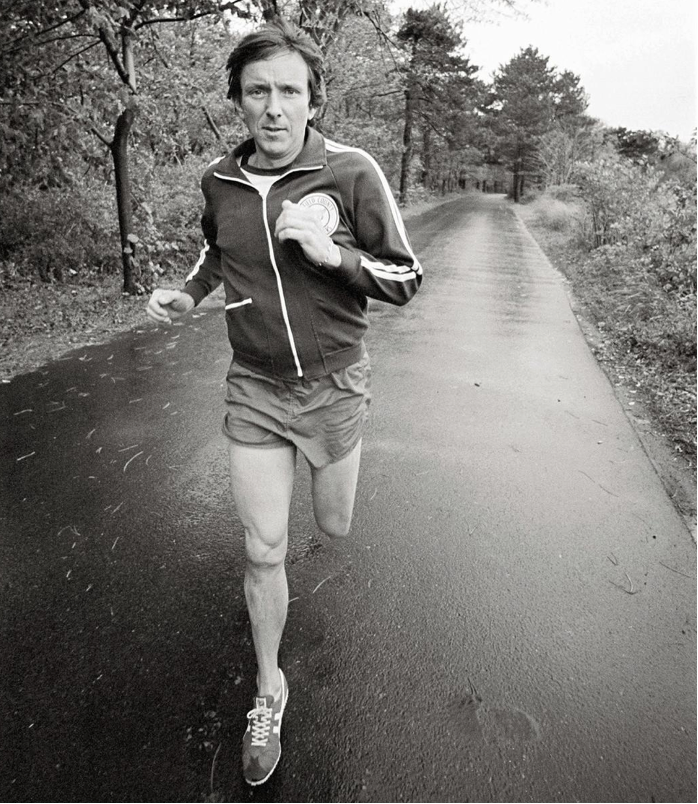
Was Jim Fixx (pictured below) consistent or obsessive?