
SERIOUS TRAINING 11
Intensity and Aging

In the last two weeks’ articles, I mentioned the 81-year-old Spanish runner Juan Lopez Garcia, who recently produced a notable marathon time of 3:39:10. You may recall that his aerobic capacity is rather high for his age at 52 mlO₂/kg/min.
I also want to mention a remarkable aging female runner I’ve been following over the last year. Jeannie Rice is 78 (pictured below) and ran a 3:33:27 marathon at age 76. She now holds her age group’s world records from 1500 meters to the marathon. A recent aerobic capacity test found her VO₂ max to be 47.8—the highest ever recorded for a woman over age 75.
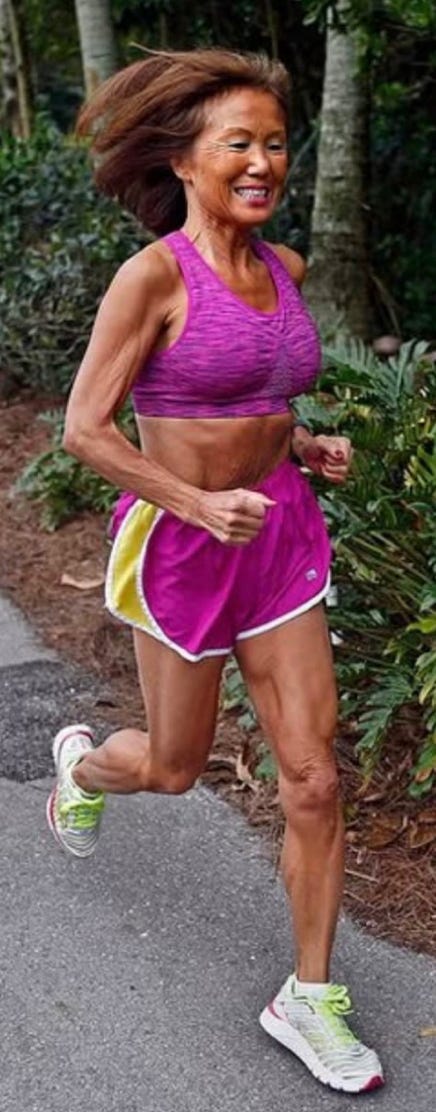
Male athletes’ aerobic capacities are typically about 10% higher than women’s of the same age and competitive level due to lower body fat, greater muscle mass, higher hemoglobin levels, and other physiological factors. But note this: even though Rice’s VO₂ max is roughly 10% lower than Lopez Garcia’s, she has produced a marathon time about 2% faster. That tells us there’s more to high performance in aging than aerobic capacity alone. Rice is certainly doing something right.
Rice didn’t start running until she was 35. Lopez Garcia began at age 66. Both are late bloomers. Someone recently asked me whether starting a sport later in life might somehow benefit performance. It’s a good question. I haven’t found research on the topic. My guess is that in people such as these two, their outstanding physiology reflects strong genetic endowment. They both did a great job of picking their parents. We weren’t all so fortunate.
Athletes in endurance sports—such as long-distance running, cycling, rowing—can often produce peak performances later in life compared with athletes in power sports like sprinting, baseball, or shot put. While physiology changes with aging, late starters can still develop into high-level age-group performers in endurance events, where experience, consistency, technique, and aerobic efficiency matter greatly. Discipline and dedication are also essential. It’s never too late.
You’re probably not in your 70s or 80s, but you may be beyond the magic age of 35—about when aerobic capacity begins to decline. Let’s take this a bit further as I introduce workouts to help keep your VO₂ max decline in line with the goal mentioned last week: less than 1% decline per year. You may even be able to temporarily reverse the downward trend.
